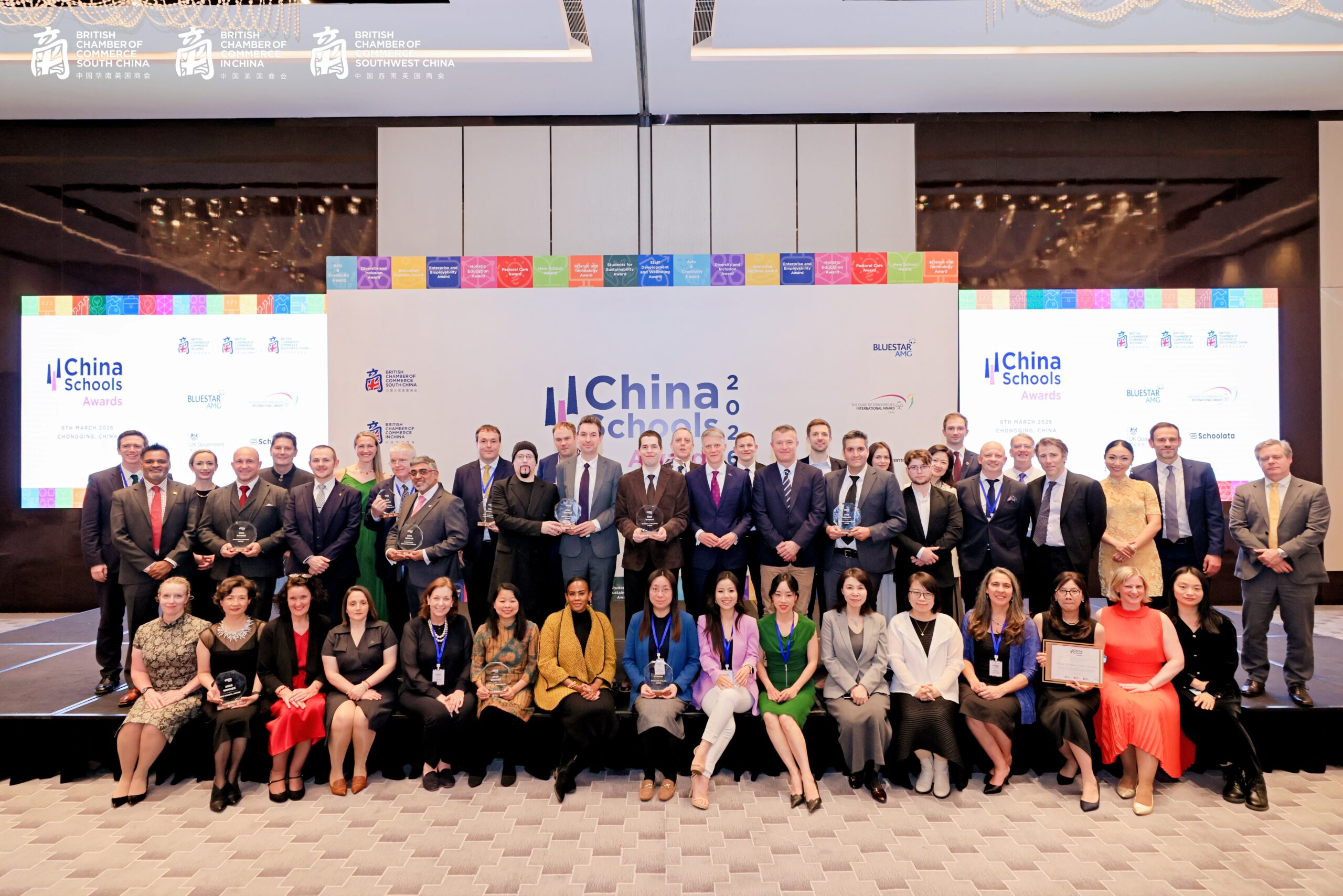
Last Friday, over 120 education leaders and professionals gathered in Chongqing for the China Schools Awards 2026, celebrating excellence and…

2026 Two Sessions in Review
A note from the British Chamber of Commerce
As China concludes its 2026 “Two Sessions” and sets direction for the 15th Five-Year Plan (2026–2030), attention is turning to how policy priorities will shape the country’s economic trajectory over the coming five years.
The following analysis, produced by British Chamber sustaining member Brunswick, offers a clear and well-grounded distillation of this year’s meetings, drawing together key signals from across a substantial body of policy material. It highlights a continued focus on steady growth supported by targeted consumption measures, alongside a sustained push towards advanced manufacturing and strategic industries under the banner of “new quality productive forces”. At the same time, development and security are increasingly intertwined, with a stronger emphasis on self-reliance, while the operating environment for foreign businesses is becoming more differentiated despite ongoing signals of openness.
You can download the Brunswick report here. A summary is below with some Chamber analysis on areas linked to the UK industrial strategy.
Key Takeaways
- Still aiming for growth
The government has set a growth target of 4.5–5% for this year, a reduction from the 5% target in place since 2023. Even at the lower end, this would represent approximately USD 880 billion in additional economic output, equivalent to adding an economy the size of Switzerland in a single year. - Boosting consumption
Reviving household confidence remains central, though support is expected to be targeted rather than broad-based. Measures are likely to include trade-in programmes, income support and selective incentives. - Still open for business
Foreign investment continues to be encouraged, with new sectors opening, renewed commitments to national treatment and a clear push for reinvestment. The operating environment will remain sector-specific, with areas linked to national priorities increasingly viewed through a security and self-reliance lens. - New quality productive forces
This concept continues to anchor policy direction, directing capital, policy support and talent towards advanced manufacturing, strategic emerging industries and frontier technologies. - Securing the nation
Development and security remain closely linked, with a whole-of-state approach to self-reliance and resilience extending beyond technology into energy, food, critical minerals, natural resources and advanced manufacturing. - Green transition continues
Despite a shift from energy intensity targets to a 3.8% carbon intensity goal, China remains committed to its green transition, with continued expansion of renewables, power market reform and strengthened environmental governance. - Navigating strategic competition
Officials were explicit about rising protectionism, unilateralism and pressure from the United States. China is deepening engagement with multilateral trade, Global South partnerships and supply chain connectivity, while strengthening its own economic resilience tools. - Building towards 2027
Next year marks the 21st Party Congress and the centenary of the People’s Liberation Army. This positions 2026 as a critical period for consolidating economic, technological, security and self-reliance priorities ahead of a major political milestone.
View from the Chamber – UK Industrial Strategy:
Building on Brunswick’s analysis, the British Chamber of Commerce in China has set out a series of short takeaways focused on areas most relevant to the UK Industrial Strategy. These reflect how these sectors operate in China and where developments in the 15th Five-Year Plan are likely to be of particular interest to stakeholders in the UK.
The sections that follow provide a brief overview of these implications across key sectors.
Advanced Manufacturing
China’s push to localise supply chains and expand industrial subsidies under the 15th Five-Year Plan is set to intensify competition, particularly as firms are encouraged to ‘buy local’ and upgrade equipment. Businesses will be looking to take advantage of these incentives and the accelerating rollout of artificial intelligence and advanced manufacturing technologies, which are already being deployed at pace across factories we have visited in recent weeks. Our survey suggests that despite geopolitical barriers, this has seen companies more likely to be adding manufacturing capacity in China than scaling it back. Back in the UK, maintaining competitiveness and understanding how to work with China will be vital.
Clean Energy Industries
China is continuing to cement its position at the centre of the global clean energy transition, with scale and investment across wind, solar and storage already reshaping global markets. There are already clear signs of UK engagement, with a number of companies advancing partnerships and investment, including those visiting during the Prime Minister’s recent visit and others introducing British capability in areas such as infrastructure and hydrogen. This sits alongside a more strategic and regulated environment, as energy, industry and national priorities become more closely aligned. The key question now is how the UK chooses to engage, particularly in determining where investment is welcomed and how to remain competitive while safeguarding national priorities.
Digital and Technology
China is accelerating efforts to strengthen its national innovation system, aligning policymakers, research institutions and industry to drive breakthroughs and bring new technologies to market more quickly. This is being reinforced by a strong push to embed innovation in the real economy, with the rapid rollout of artificial intelligence and frontier technologies already visible across sectors. Access to innovation and collaboration opportunities will be attractive to foreign companies, though this sits alongside a growing emphasis on data sovereignty and localisation. The pace of technological adoption is set to increase the competitiveness of industry, requiring companies to adapt quickly to remain aligned with developments on the ground.
Life Sciences
China’s life sciences sector has been a policy priority for several years and has expanded faster and more broadly than many expected, with recent growth in licensing activity underlining the rising global relevance of Chinese biopharma. Recent policy signals point to further support for biomedicine, high-end medical devices and other frontier technologies, alongside a clearer pathway for industrial scaling. This is already being reflected in major commercial activity, including a growing number of cross-border licensing deals and large-scale investment commitments such as AstraZeneca’s USD 15 billion China investment announced during the Prime Minister’s visit. At the same time, incremental opening measures, including pilot schemes for wholly foreign-owned hospitals, sit alongside a more difficult question over long-term payment and reimbursement, as China continues to prioritise affordability and faces mounting demographic pressure from an ageing population.
Creative Industries
The Prime Minister’s visit saw him bring a diverse delegation of British stakeholders across museums, arts, sport and music, indicating that the creative industries are a growing priority in UK–China engagement. This aligns with China’s latest Five-Year Plan, which places greater emphasis on expanding “experience-based consumption” across culture, tourism, entertainment and sport as part of efforts to boost domestic demand. Early signs of commercial traction, including partnerships and deals linked to the visit, point to a developing appetite for collaboration in areas where the UK has clear strengths. As China looks to scale its cultural and experiential economy, this creates a meaningful opportunity for deeper engagement, particularly in areas such as experiential tourism, live events and creative content.
Financial Services
The UK–China Economic and Financial Dialogue (EFD) last year placed financial services firmly at the centre of bilateral engagement, with a strong emphasis on collaboration as Chinese firms look to expand globally. Since then, engagement has deepened at a more technical level, reflecting continued interest in areas where the UK has clear strengths, including capital markets, asset management and green finance. China is also taking steps to improve how capital flows into priority sectors, including refining processes for listings and mergers to give investors clearer entry and exit routes, and expanding channels for long-term investment into innovation. This points to a constructive direction of travel, though the pace and impact will depend on how reforms are implemented and the balance struck between opening and broader policy objectives.
Professional and Business Services
Professional and legal services remain a core area of strength for the UK and an important avenue for engagement with China, particularly as Chinese companies continue to expand internationally. There have been further signs of market opening in the legal sector, and our latest Sentiment Survey found law firms to be among the most optimistic respondents, reflecting growing demand for cross-border advisory, compliance and international structuring. Supporting Chinese firms as they “go global” is emerging as a key area of activity, both into the UK and across other markets where British expertise is well established. This is an area of clear interest for policymakers on both sides, though how this develops in practice will depend on the evolution of regulatory frameworks and the pace at which outbound activity continues to grow.
Related Posts