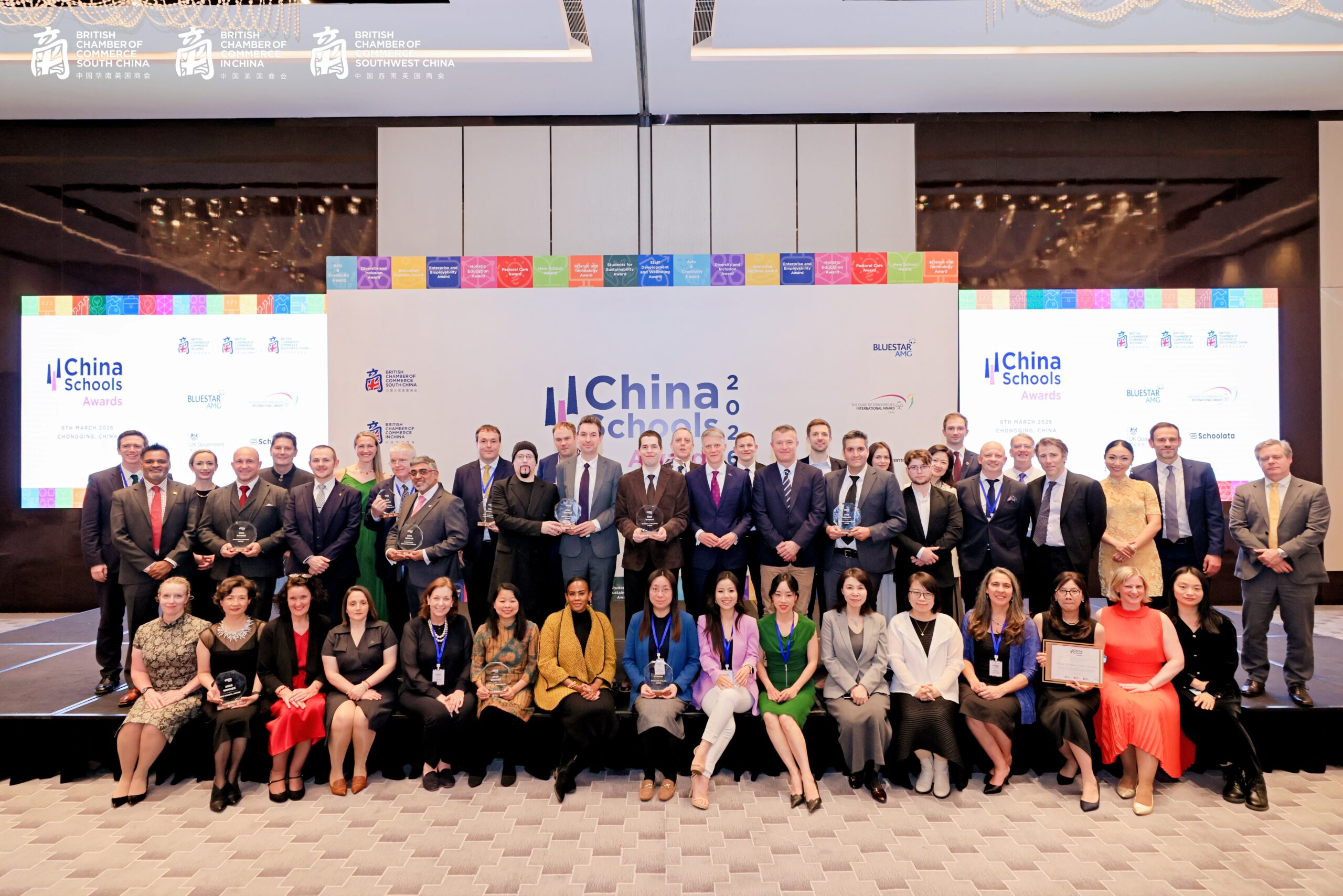
Last Friday, over 120 education leaders and professionals gathered in Chongqing for the China Schools Awards 2026, celebrating excellence and…
End of Year Letter from the Managing Director
As we close the Year of the Snake, this Spring Festival marks one year since I returned to China and one year serving as Managing Director of the British Chamber of Commerce in China.
Coming back to Beijing after five years away was a reminder that China rarely stands still. The improvement in air quality is evident. Significant investment in environmental clean-up has made the city markedly more liveable. At the same time, China’s technological confidence has expanded well beyond consumer and mobile innovation into advanced manufacturing. The prominence of domestic electric vehicle brands, many unfamiliar to me when I left, is perhaps the clearest illustration of that shift.
The broader economic transition is equally visible in daily life. For two decades, property and infrastructure were the principal engines of growth. It is clear that this model can no longer play the same central role. Construction projects in central business districts such as Guomao remain stalled, while premium office vacancy rates have risen as firms reassess costs and footprint. The adjustment in the property sector is visible and ongoing.
Policymakers have accepted that property cannot continue to anchor growth in the way it once did. Capital has been redirected toward manufacturing and technological upgrading. Electric vehicles, batteries, renewables, advanced machinery and digital infrastructure are absorbing investment that previously flowed into real estate.
This approach is delivering formidable industrial capacity. It also creates pressure points. With property subdued and household confidence cautious, domestic demand has not fully absorbed the increase in output. Price competition has intensified across sectors, with recent vehicle price reductions among the sharpest in recent years. What is often described domestically as involution reflects firms competing aggressively for market share in a thin-margin environment. Local governments, tasked with sustaining growth and employment, continue to support local champions, reinforcing competitive pressure in already crowded industries.
The result is a two-track economy. Industrial capability and exports are strengthening, while consumer sentiment remains restrained. Our most recent Sentiment Survey indicates that only a minority of British firms expect a significant near-term rebound in consumer demand, and many report customers trading down. This aligns with what is visible in Beijing’s retail landscape, where competitively priced lifestyle brands are expanding while premium segments face softer demand. At the same time, closer examination of consumption trends highlights opportunity in areas such as the experience economy, which continues to evolve despite broader caution.
For British businesses operating in China, this environment is complex.
Fifty seven percent of respondents to our latest Sentiment Survey reported that doing business in China became more difficult over the past year. Regulatory opacity, procurement complexity and uneven competitive conditions remain central concerns. Market access continues to feature prominently in our Position Paper, including calls for greater transparency in licensing, clearer procurement rules and more predictable implementation at provincial and municipal levels. Many of these issues have appeared consistently since the very first iteration of our Position Paper.
Tariff asymmetries also persist in certain categories where British exporters continue to face higher tariff barriers than Chinese firms exporting in the opposite direction. Our Position Paper reiterates the importance of addressing such imbalances through structured dialogue. In this context, the recent reduction in tariffs on whisky imports into China stands as both a tangible commercial benefit and a reminder that sustained engagement can produce practical results.
Despite these challenges, British companies are not disengaging.
The structure of the UK economy shapes our relative resilience. The United Kingdom’s comparative advantage lies heavily in professional services, legal advisory and financial services. These sectors complement China’s industrial push rather than compete directly with it. As Chinese firms expand overseas, they require capital markets access, compliance expertise and cross-border advisory support. British firms are well placed to provide that expertise.
Survey data reflects this relative confidence. While overall sentiment remains mixed, respondents in legal and financial services report higher levels of optimism than in many goods-producing sectors. Alignment between the UK’s Modern Industrial Strategy and China’s priorities in advanced manufacturing, green transition and healthcare innovation also creates space for constructive cooperation.
Geopolitics continues to influence boardroom decision-making. Very few British firms are exiting China, but many are sequencing or recalibrating investment in response to global uncertainty. Continued government-to-government engagement, therefore, remains important. The Prime Minister’s visit earlier this year signalled pragmatic engagement and delivered progress on several longstanding Position Paper priorities. Outcomes relating to sporting event regulation, the import of classic vehicles and recognition of certain vocational qualifications will create practical opportunities for British firms. A commitment to begin a feasibility study on enhanced services trade cooperation also has the potential, over time, to contribute to a more balanced bilateral trading relationship.
Looking ahead, sustained ministerial dialogue between the United Kingdom and China is expected to continue. Predictability and communication are essential in a shifting economic and geopolitical environment.
We are particularly encouraged by progress toward visa-free access for UK passport holders travelling to China. Our members consistently emphasise that mobility underpins commercial success. Reducing friction for business travel will accelerate decision-making and strengthen relationships. Increased people-to-people exchange can only deepen mutual understanding. Living and working in Beijing each day reinforces how much direct interaction matters in countering simplified narratives.
At the Chamber level, the coming year will be active. Alongside the continued evolution of our regular event calendar, we look forward to the return of the British Business Awards in Beijing. Held every four years in the capital, the Awards celebrate companies that are genuinely in China, for China. They also provide valuable opportunities for engagement with national and municipal leaders. In a year when a new Five-Year Plan is released, structured business-to-government dialogue is especially important to ensure British firms are well-positioned to contribute to evolving priorities.
Finally, I am pleased to confirm that for the seventh consecutive year, we will freeze our membership fees. Small and medium-sized enterprises form the backbone of our membership, and many are operating in a tighter margin environment. Like our members, we are managing costs carefully while maintaining the quality of our advocacy and services. We remain incredibly grateful for the long-term support of our membership.
It has been a privilege to deepen relationships with our members and with stakeholders across government over the past year. China’s economy continues to evolve, and disciplined, informed engagement remains essential. I look forward to building on that foundation in the year ahead.
新年快乐,马到成功
Graeme Wallace
Related Posts